
Carbon (C)
“One element, three personalities: pencil-soft black graphite, hardest-natural diamond and football-shaped fullerenes — every one of them pure carbon.”
How its electrons are arranged
Computed from the aufbau principle, with known real-world exceptions applied automatically.
The notes
Characteristics
- Tetravalent to the bone: four valence electrons let a carbon atom hold four strong covalent bonds at once, so it can build chains, rings and branches — the skeleton of every organic molecule.
- Champion of self-bonding (catenation): no other element links into such long, stable chains of itself, which is why millions of carbon compounds are known — more than all other elements combined.
- Allotropy at the extremes: diamond, the hardest natural material and an electrical insulator; graphite, soft enough to rub off on paper yet a good conductor; plus fullerenes, nanotubes and one-atom-thin graphene.
- The engine of life: proteins, fats, carbohydrates and DNA all stand on carbon backbones, and the slow decay of carbon-14 lets archaeologists read the age of ancient bones and wood.
A solid nonmetal of wildly different faces: sparkling, colourless diamond; black, flaky, slippery graphite; sooty charcoal powder; and nanoscale spheres and tubes. It never melts in an ordinary flame — at atmospheric pressure it skips the liquid state altogether and turns straight into vapour above 3,600 °C.
Where you meet it
✦ Uses
- Coke — coal stripped of its impurities — is charged into blast furnaces to snatch oxygen away from iron ore; the world’s steel, including every rafter in Dhaka, begins with coke.
- Graphite: the “lead” inside every pencil, the electrodes of arc furnaces and dry cells, and the neutron-slowing moderator at the heart of many nuclear reactors.
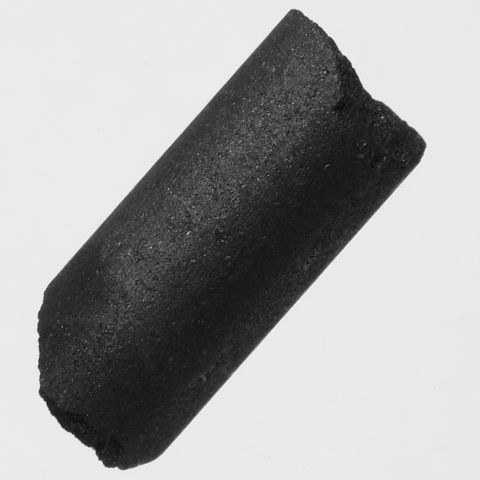
- Activated carbon — the black granules inside household water purifier cartridges — soaks up chlorine, pesticides and bad odours from drinking water.
- Diamond-tipped drill bits, saws and polishing paste for cutting glass, stone and concrete, and carbon-fibre frames for aircraft, racing bikes and badminton rackets that beat steel at a fraction of the weight.
◍ Everyday examples
- The pencil in a student’s geometry box writes with stacked sheets of graphene — pure carbon sliding off onto the page.
- Sugar, rice, dal, fish and cooking oil are all carbon-based foods; digestion merely reshuffles their carbon skeletons.
- The soot blackening the bottom of an aluminium degchi, or the charcoal glowing under a street kebab grill — everyday carbon at work.
History & name
Carbon has no single discoverer — charcoal, soot and wood smoke were humanity’s companions long before chemistry had a name. Indians were treasuring diamonds by the fourth century BCE, and graphite was being used for marking by the 1500s. In 1772 Antoine Lavoisier burned a diamond with a burning lens and showed that nothing came off but carbon dioxide — quietly proving that diamond and charcoal are the same element — and in 1789 he entered carbon in his historic list of the elements. The name comes straight from the Latin carbo, “charcoal”.
Nearby elements
The elements that sit right beside this one on the table — often the closest chemical cousins.