
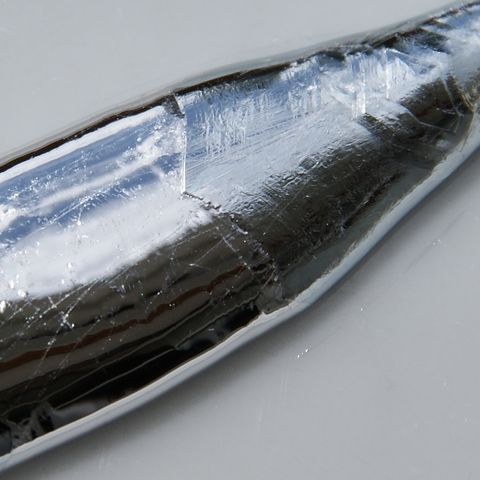
Gallium (Ga)
“The metal that melts in a warm fist at 29.8 °C — and that lights up phone screens as brilliant GaN LEDs.”
How its electrons are arranged
Computed from the aufbau principle, with known real-world exceptions applied automatically.
The notes
Characteristics
- Melts at 29.8 °C — lower than a hot Dhaka afternoon — yet boils only near 2400 °C, one of the widest liquid ranges of any element.
- Electron configuration [Ar] 3d¹⁰ 4s² 4p¹ — three valence electrons, so it shares Group 13 with boron and aluminium and usually forms Ga³⁺ compounds.
- Combines with arsenic and nitrogen into GaAs and GaN — semiconductors that convert electricity straight into LED and laser light.
- Like water, it expands slightly on freezing; liquid gallium also wets glass and leaves mirror-bright streaks wherever it flows.
- A key ingredient of Galinstan (gallium-indium-tin alloy), the non-toxic liquid metal that replaces mercury in modern thermometers.
A soft, silvery-blue metal that looks like a calm cousin of mercury yet is safe to touch. It melts at just 29.8 °C — the grip of a hand or a cup of hot tea will turn a spoon-shaped solid piece into a shining puddle.
Where you meet it
✦ Uses
- Gallium nitride (GaN) blue and white LEDs — the invention behind the 2014 chemistry Nobel that lights phone screens, bulbs and billboards.
- Gallium arsenide (GaAs) chips in smartphones and satellites — faster than silicon and doubling as the laser diodes that carry internet traffic through optical fibre.
- Galinstan medical thermometers — mercury-free and safe, now standard in hospitals as mercury instruments are phased out.
- Gallium-arsenide solar panels on satellites and space probes, which keep making power where ordinary silicon panels would fade.
◍ Everyday examples
- The smartphone in your pocket hides a sprinkling of gallium in its screen’s LED backlight and its high-frequency signal chips.
- On a 35 °C summer day in Bangladesh, a gallium spoon left outdoors would quietly melt into a shiny puddle.
- Gallium never occurs free in nature — it hides in traces inside bauxite and zinc ores, so refineries rescue it as a by-product.
History & name
In 1871 Mendeleev left a blank in his new periodic table for an undiscovered element he called eka-aluminium — boldly predicting its atomic mass, its density (about 5.9) and even its low melting point. In 1875 the French chemist Paul-Émile Lecoq de Boisbaudran found two unfamiliar violet lines in the spectrum of a zinc-blende ore from the Pyrenees and isolated the new metal by electrolysis. When Lecoq’s first density reading came out at 4.7, Mendeleev himself wrote insisting he re-measure; the corrected value, 5.9, matched the prediction and made the periodic table famous overnight. Lecoq named the element gallium after Gallia, Latin for his homeland, France.
Nearby elements
The elements that sit right beside this one on the table — often the closest chemical cousins.