
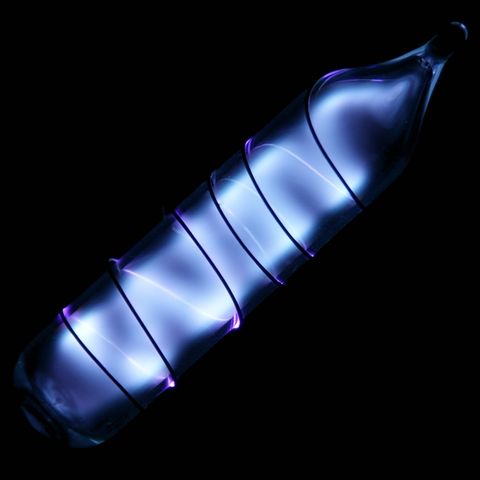
Xenon (Xe)
“The stranger that broke chemistry’s strictest rule — aloof for sixty-four years, until 1962 when xenon stunned the world by forming real compounds.”
How its electrons are arranged
Computed from the aufbau principle, with known real-world exceptions applied automatically.
The notes
Characteristics
- Electron configuration [Kr] 4d¹⁰ 5s² 5p⁶ — a filled outer shell of eight valence electrons (Period 5, Group 18), the textbook root of its aloofness.
- Not truly inert after all: its huge atom holds its outer electrons loosely, so fierce fluorine can seize them — , , and even are known.
- One of the heaviest gases you will ever meet — about 4.5 times the density of air; a balloon of it sinks, unlike helium or neon balloons.
- A genuine anaesthetic: dissolved in nerve tissue, xenon switches consciousness off painlessly and wears off remarkably fast, with almost no side effects.
A colourless, odourless, utterly quiet gas at room temperature — about four and a half times denser than air, the heaviest of the non-radioactive noble gases. Like the rest of its family it drifts around as single atoms, and in a sealed tube under high voltage it glows a striking blue-white.
Where you meet it
✦ Uses
- Xenon (D) car headlamps on premium cars — a tiny arc of xenon under high voltage throws crisp daylight-white beams far down dark highways.
- Anaesthesia in the operating theatre — xenon puts patients under smoothly and lets them wake within about two minutes, safe enough even for heart-surgery patients.
- Xenon-chloride excimer lasers whose ultraviolet pulses reshape the cornea in LASIK eye surgery; the same gas fills the flash lamps of cameras.
- Ion thrusters on spacecraft and communications satellites — electric fields fling xenon ions backward at tens of kilometres per second, gently, for months on end.
◍ Everyday examples
- On a Bangladeshi highway at night, the piercing blue-white headlights of an expensive sedan are a small xenon arc at work.
- A friend or relative freed from spectacles by LASIK surgery owes that sharp vision partly to xenon’s invisible ultraviolet flashes.
- NASA’s Dawn spacecraft toured the giant asteroid Vesta and the dwarf planet Ceres on nothing but the patient push of xenon ion engines.
History & name
On 12 July 1898, six weeks after bagging krypton, William Ramsay and Morris Travers fractionally distilled the very last drops of their liquid-air residue — the heavy fraction nobody had bothered to chase. The tube glowed a beautiful sky-blue, and the spectroscope revealed a ladder of unknown lines: yet another new gas. Ramsay named it xenon from the Greek xenos, “stranger” — a guest that had lurked invisible in air since the planet formed. For sixty-four more years it kept its noble distance, until Neil Bartlett’s of 1962 shattered the textbook myth that noble gases never react.
Nearby elements
The elements that sit right beside this one on the table — often the closest chemical cousins.