
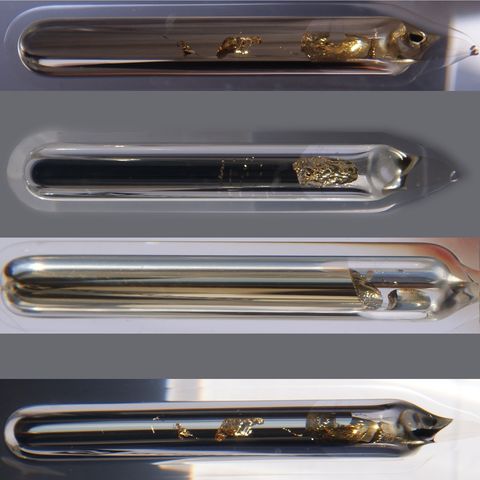
Caesium (Cs)
“The metal that melts in the palm of your hand — and whose atoms now define, vibration by vibration, every second the world lives by.”
How its electrons are arranged
Computed from the aufbau principle, with known real-world exceptions applied automatically.
The notes
Characteristics
- Electron configuration [Xe] 6s¹ — a single, loosely held valence electron giving the lowest ionisation energy of all stable elements; Period 6, Group 1, heavyweight of the alkali metals.
- Frightfully reactive: it explodes on meeting water — even ice more than a hundred degrees below zero — skating across the surface as the hydrogen around it bursts into flame.
- Melts at 28.5 °C, the heat of a warm Dhaka afternoon; held in a sealed vial, a lump slowly goes liquid from the warmth of your palm alone.
- Pale gold rather than silvery — one of only three metals, with gold and copper, that absorb blue light instead of reflecting it all.
The softest metal of all — a pale golden block that dents under a spoon, and one of only a handful of metals liquid near room temperature, melting at just 28.5 °C. Dry air alone sets it burning, so it lives sealed in glass ampoules under argon or oil.
Where you meet it
✦ Uses
- The definition of time itself: 9,192,631,770 vibrations of a caesium-133 atom’s microwave transition make one SI second, and the best caesium clocks would not drift a second in a hundred million years.
- Every GPS satellite and telecom network leans on caesium-trained clocks, so that a map app on a Dhaka bus and every phone tower’s signal handshake stay in perfect step.
- Caesium formate brines — extraordinarily dense yet kind to equipment — stabilise scorching, high-pressure oil and gas wells during deep drilling.
- Photocathodes that spill electrons at the merest whisper of light: caesium surfaces sit inside night-vision tubes, photomultipliers and old television camera tubes.
◍ Everyday examples
- The “second” printed in your physics textbook is defined by neither the Sun nor a pendulum but by caesium-133 — the only element that owns an SI unit.
- The map app that tracks a CNG or bus through Dhaka positions itself using satellite time that is ultimately disciplined by caesium standards.
- Wildlife documentaries’ grainy green night footage is often captured through tubes whose caesium-coated surfaces can see almost in the dark.
History & name
In 1860 Robert Bunsen and Gustav Kirchhoff in Heidelberg pointed their brand-new spectroscope at the mineral water of Dürkheim and caught two bright sky-blue lines belonging to no known element — making caesium the first element ever discovered by spectroscopy. They named it from the Latin caesius, “sky-blue”. So scattered was the metal that Bunsen never once saw it pure; only in 1882 did Carl Setterberg, electrolysing molten caesium cyanide, finally pry out the first visible drops of the golden metal.
Nearby elements
The elements that sit right beside this one on the table — often the closest chemical cousins.