
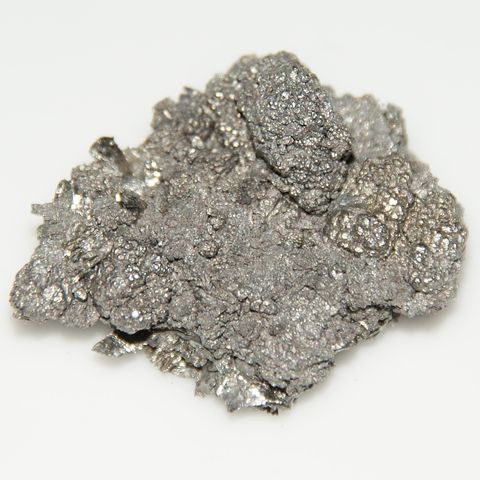
Hafnium (Hf)
“The element named after Copenhagen — predicted by Bohr’s theory, and now the invisible insulation inside every smartphone processor.”
How its electrons are arranged
Computed from the aufbau principle, with known real-world exceptions applied automatically.
The notes
Characteristics
- Electron configuration [Xe] 4f¹⁴ 5d² 6s² — period 6, group 4, d-block, four valence electrons; the workhorse ion is Hf⁴⁺.
- A near-perfect chemical twin of zirconium: lanthanide contraction has shrunk Hf⁴⁺ to practically the same ionic radius as Zr⁴⁺, so the two metals occur together everywhere and are notoriously hard to separate.
- Nuclear split personality: hafnium devours neutrons roughly 600 times more eagerly than zirconium — which is exactly why one twin becomes reactor control rods while the other sheaths the fuel.
- A refractory, corrosion-proof metal (melting point 2233 °C); its carbide HfC, melting near 3900 °C, stands among the most heat-proof compounds known.
A silvery-grey, lustrous transition metal that resists corrosion and keeps its polish in air. It is noticeably heavy for its size (density about 13.3 g/cm³) and rolls into tough, corrosion-proof foils and wires.
Where you meet it
✦ Uses
- Control rods in nuclear reactors and naval propulsion plants — hafnium’s neutron-hungry isotopes throttle or shut down the chain reaction on demand.
- High-k gate insulation in modern microchips: since 2007–08, hafnium oxide () has replaced silicon dioxide inside processors, including the chip in your smartphone.
- Nickel superalloy turbine blades — a few percent of hafnium toughens the grain boundaries of blades in jet engines and power turbines.
- Ultra-hot engineering: hafnium carbide, alone or alloyed with tantalum carbide, armours rocket throats and cutting tools, while old-style camera flashbulbs once burned hafnium foil.
◍ Everyday examples
- The processor inside a smartphone or laptop almost certainly depends on a hafnium-oxide insulating layer only a few atoms thick.
- Zircon — the beach-sand mineral being traced along Bangladesh’s Cox’s Bazar coast — always carries a few percent of hafnium piggybacking on the zirconium.
- Nuclear submarines and aircraft-carrier fleets glide for decades on reactors steered by hafnium control rods.
History & name
Niels Bohr’s new atomic theory signalled in 1922 that the still-missing element 72 should be a transition metal resembling zirconium rather than a rare earth. Acting on that tip-off, Dirk Coster and George de Hevesy, working in Bohr’s Copenhagen institute, shot X-rays through Norwegian zircon and in early 1923 read the tell-tale lines of the new element — a discovery guided by theory and confirmed by X-ray spectroscopy. They named it hafnium after Hafnia, the Latin name of Copenhagen, honouring the city of its birth.
Nearby elements
The elements that sit right beside this one on the table — often the closest chemical cousins.