
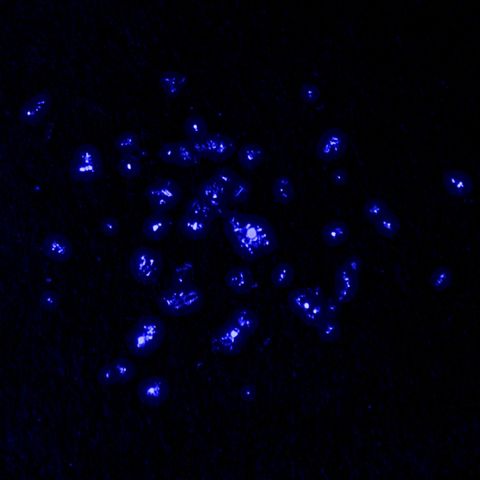
Actinium (Ac)
“The metal that named the periodic table’s second f-block row — so radioactive that it glows pale blue in the dark, about 150 times stronger than radium.”
How its electrons are arranged
Computed from the aufbau principle, with known real-world exceptions applied automatically.
The notes
Characteristics
- Electron configuration [Rn] 6d¹ 7s² — period 7, group 3, head of the f-block actinides; it dissolves as Ac³⁺, a chemical double of lanthanum, and its atom carries not one 5f electron.
- Ac-227, half-life about 22 years, anchors the natural actinium decay series and sits in the uranium-235 chain; gram for gram the metal is roughly 150 times as radioactive as radium.
- Ac-225, half-life 9.9 days, is a ferocious alpha emitter — a single decay can kill a cancer cell, which is exactly why medicine prizes it; a year’s whole global supply would fit in a thimble.
- Extremely radiotoxic: it hitches a ride on the body’s iron-transport chemistry and piles up in liver and bone marrow, so visible samples are handled only inside sealed gloveboxes.
A soft, silvery-white metal that tarnishes quickly in air. Its fierce radiation constantly ionizes the surrounding air, so a sample in a dark room sheds a ghostly pale-blue glow — the same eerie light the Curies’ generation knew so well.
Where you meet it
✦ Uses
- Actinium-225 in targeted alpha therapy: welded to tumour-hunting molecules such as PSMA-617, it fires lethal alpha particles straight into prostate and other cancer cells — one of nuclear medicine’s most promising new weapons.
- Actinium-227 blended with beryllium builds compact neutron sources for physics experiments and reactor instrumentation, because its decay knocks neutrons loose from beryllium.
- The medical isotope Ac-225 is “milked” from carefully kept thorium-229 stockpiles — a supply chain only a handful of nations maintain, making the isotope one of the world’s scarcest medicines.
- Historically studied as a heat source for long-lived batteries, but its vicious accompanying gamma rays handed the space programme’s job to plutonium-238 instead.
- Its well-mapped decay chain serves as a calibration yardstick for radiation detectors and as the classroom example of the actinium series in nuclear chemistry courses.
◍ Everyday examples
- Any lump of uranium ore quietly carries actinium: each tonne of uranium holds only about a fifth of a milligram — precisely the trace Debierne chased through the Curies’ leftovers in 1899.
- Every periodic table a student opens bears actinium’s signature: the whole fifteen-member actinide row, thorium to lawrencium, is named after this one element.
- Newspaper health pages reporting “alpha therapy” or PSMA-617 cancer trials are almost always telling an actinium-225 story — the element reaches students through medical headlines.
History & name
In 1899, sifting through the pitchblende residue the Curies had discarded after extracting radium, French chemist André-Louis Debierne separated yet another new radioactive element and named it actinium, from the Greek aktis, “ray”. Friedrich Giesel independently found it in 1902 and for a while called it “emanium”, but Debierne’s name prevailed. As the first member of its row, actinium eventually gave the entire actinide series its name — though for decades textbooks wrongly parked it beside lanthanum, until Seaborg’s actinide concept of 1944 set the row straight.
Nearby elements
The elements that sit right beside this one on the table — often the closest chemical cousins.