
Mercury (Hg)
“The only metal that runs like water and shines like silver — and whose invisible vapour taught the world the meaning of “poisoning”.”
How its electrons are arranged
Computed from the aufbau principle, with known real-world exceptions applied automatically.
The notes
Characteristics
- Liquid at room temperature because its 5d¹⁰ 6s² shells are filled and grip their electrons tightly — metallic bonding is so weak that the metal flows apart above −39 °C.
- It swallows many other metals to form amalgams: silver–tin amalgam filled teeth for a century, and artisanal gold miners still bind gold into a mercury paste — a banned but stubborn practice.
- The vapour is a silent poison — colourless, odourless, accumulating in nerves and kidneys; “mad as a hatter” remembers hat-makers shaking from mercury nitrate, and Minamata’s fish-borne epidemic showed methylmercury climbing the food chain.
- Chemically aloof yet even-tempered: it ignores dilute acids that eat iron, but expands smoothly and uniformly with temperature — the very property that made it the world’s thermometer fluid.
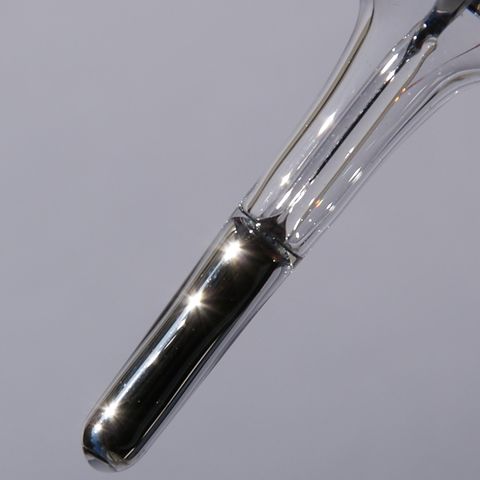
A heavy, silvery liquid — the only metal that is liquid at room temperature, freezing only at −39 °C. Its surface tension is so high that spilled mercury breaks into skittering beads, and a one-litre bottle of it would drag the scale to about 13.5 kilograms.
Where you meet it
✦ Uses
- Thermometers, blood-pressure gauges and Torricelli-style barometers — the silver thread that measured fevers and weather alike for three centuries, now surrendering to digital sensors under the Minamata Convention, to which Bangladesh is a party.
- Fluorescent tubes and CFL bulbs: the electric discharge through mercury vapour gives ultraviolet, and the phosphor coating on the glass turns that UV into white light.
- Dental amalgam — mercury triturated with a silver–tin alloy — set into fillings that served hundreds of millions of teeth through the twentieth century.
- The classical calomel reference electrode of potentiometry, and the historic gold-miner’s amalgam trap for catching alluvial gold before cyanide leaching took over.
◍ Everyday examples
- The old glass thermometer rolling in the family medicine box, its silver thread of mercury, is now handed in as hazardous waste rather than binned.
- Each classroom or office fluorescent tube carries a few milligrams of mercury vapour — the reason broken tubes go to special recycling, never to the open bin.
- Traditional red sindoor was historically coloured with cinnabar — mercury sulfide (), the very ore from which the metal itself is roasted out.
History & name
Mercury has been known since antiquity: Egyptian tombs from about 1500 BCE preserve vials of it, and alchemists prized the “living silver” as an essence of metallicity itself. The Greeks called it hydrargyros, “water-silver”, which Latin folded into hydrargyrum and chemistry into the symbol Hg; the English name honours the swift messenger god Mercury — quicksilver in plain speech. Torricelli balanced a column of it against the atmosphere in 1643 and invented the barometer, and for three centuries mercury thermometers were the world’s standard — until Minamata’s tragedy in 1950s Japan revealed the metal’s dark side and led, in 2013, to the Minamata Convention now retiring it worldwide.
Nearby elements
The elements that sit right beside this one on the table — often the closest chemical cousins.