
Thallium (Tl)
“Discovered by a green line in a flame, feared as the tasteless “poisoner’s poison” — now injected to photograph a struggling heart.”
How its electrons are arranged
Computed from the aufbau principle, with known real-world exceptions applied automatically.
The notes
Characteristics
- One of the most toxic of the common metals: odourless and nearly tasteless Tl⁺ ions hijack the body’s potassium channels, causing burning nerve pain and dramatic hair loss — signs easily mistaken for other diseases.
- A split personality in group 13: like boron and aluminium it can show +3, but the inert pair effect makes the +1 state of Tl⁺ so stable that its salts behave almost like silver’s.
- Physically lead-like — soft, dense (11.85 g/cm³), low-melting near 304 °C — yet unlike lead it melts obligingly in the flame of an ordinary spirit lamp.
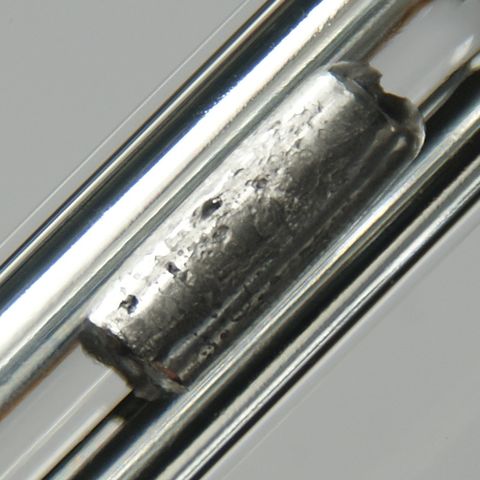
- It tarnishes quickly in moist air as it reacts with oxygen and water vapour, so laboratories store sticks of it under oil or in sealed ampoules, much like the alkali metals.
A soft, bluish-grey metal soft enough to score with a fingernail and slice with a knife. A fresh cut gleams like newly cast lead, but within minutes in open air a dull grey oxide film creeps across the shine.
Where you meet it
✦ Uses
- Nuclear cardiology: thallium-201 chloride is injected for heart stress tests — mimicking potassium, healthy heart muscle absorbs it and lights up the gamma-camera image of the blood supply.
- Thallium-doped scintillator crystals — NaI(Tl) and CsI(Tl) — convert invisible gamma rays and X-rays into countable flashes of light inside hospital gamma cameras and security scanners.
- Infrared optics: crystals of thallium bromide–iodide transmit long-wavelength infrared, serving thermal-imaging lenses, -laser windows and infrared spectrometers.
- The former rodenticide thallium sulfate — banned in most countries once its human toll was tallied; it survives mainly in crime fiction and forensic textbooks as the classic “poisoner’s poison”.
◍ Everyday examples
- A heart patient leaving the nuclear-medicine wing of a big city hospital may have just had a thallium-201 scan map the blood flow through the heart muscle.
- Airport baggage scanners and hospital gamma cameras owe their light-flashing detector crystals to a pinch of thallium doping.
- Crime-fiction shelves keep thallium famous: in The Pale Horse the victims’ burning feet and shedding hair are the textbook symptoms of its poisoning.
History & name
In 1861 William Crookes, examining the gunky residue from a sulfuric-acid plant, spotted in its flame spectrum a brilliant green line belonging to no known element — and named the newcomer thallium, from the Greek thallos, a fresh green shoot of spring. Claude-Auguste Lamy in France isolated the metal itself the next year. Its tasteless sulfate became a notorious rat poison in the twentieth century — and Agatha Christie’s 1961 thriller The Pale Horse described thallium poisoning so accurately that readers have recognised real cases from its pages.
Nearby elements
The elements that sit right beside this one on the table — often the closest chemical cousins.